


Every time you asked AI for help, did you unknowingly hand over your company’s confidential data? Recent AI data breach incidents prove the risks you take when you input company data into OpenAI.
A case study with Samsung employees proves that entering sensitive data into public AI tools risks workplace data breaches. When you input information, it is stored on OpenAI’s servers and remains accessible to other users outside your network.
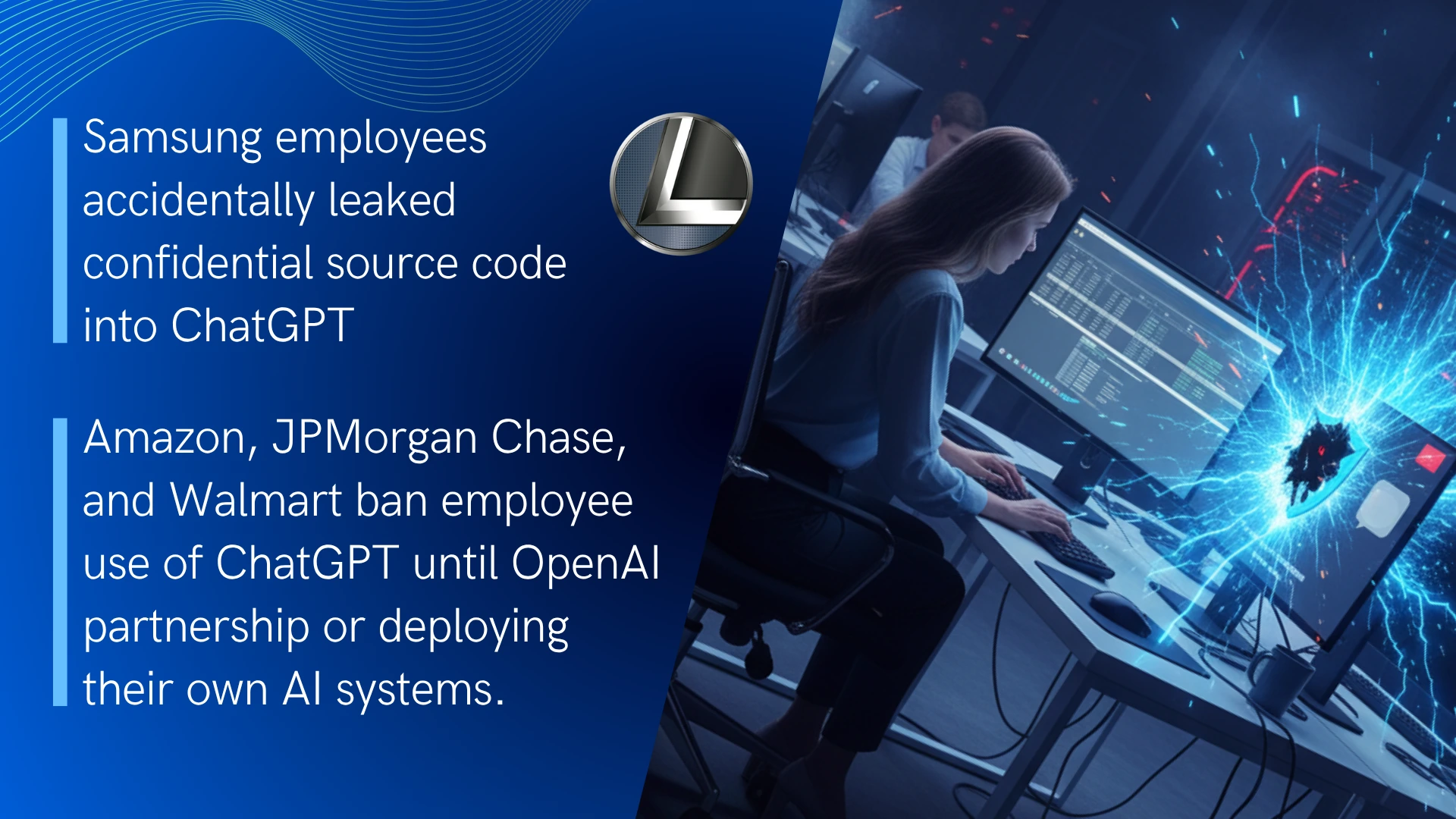
Samsung AI Data Breach
In 2023, Samsung faced a widespread data breach within their company due to uncontrolled employee use of ChatGPT and OpenAI. Samsung employees leaked confidential source code into ChatGPT for help with code optimization and meeting summaries. They didn’t realize that these inputs not only exposed Samsung’s confidential data, but also threatened Qualcomm, a leading U.S. chipmaker.
This breach made their strategies and data vulnerable to competitors. Samsung banned the use of AI tools within their company, then later developed its own internal secure AI platform.
Company Strategies to Prevent AI Data Breaches
Recognizing the importance of having internal AI safeguards, major organizations including Amazon, JPMorgan Chase, and Walmart have tightened their security. These companies implemented higher internal controls and access limitations. These measures were designed to strengthen employee safeguards and maintain greater control over the use of artificial intelligence.
Amazon: Driven by data security concerns from ChatGPT platforms in 2023, Amazon implemented a policy restricting employee use of AI chatbots. To later address this, the company introduced its’ in-house AI tool, Cedric. Reports show Cedric contains security advantages over ChatGPT. It securely executes essential tasks such as document summarization and accurate information retrieval.
JPMorgan Chase: JPMorgan Chase initially restricted external AI usage in 2023 to protect proprietary data. However, the firm has since deployed its’ own internal AI platform called the LLM Suite. Chief Data & Analytics Officer, Teresa Heitsenrether, revealed, “Since our data is a key differentiator, we don’t want it being used to train the model. We’ve implemented it in a way that we can leverage the model while still keeping our data protected.” This ensures that the company can implement AI while maintaining strict control over its valuable data.
Walmart: Walmart initially restricted the use of AI by its employees in 2023. This restriction was recently lifted following their new partnership with OpenAI on October 14th of this year. Walmart has implemented safeguards including mandatory AI literacy programs, comprehensive training, and certification requirements. These are designed to ensure employees understand AI’s proper use and confidentiality protocols to prevent accidental disclosure of confidential data.