
FB Pixel

Wi-Fi 6, 6E, vs. Wi-Fi 7

As a business owner, you don’t need to be an IT engineer to know that a slow, unreliable Wi-Fi network kills productivity and leaves your network vulnerable. In the last few years, wireless technology has made massive leaps forward.  

You’ve likely heard terms like “Wi-Fi 6,” “Wi-Fi 6E,” and now “Wi-Fi 7″ thrown around, but what do they mean for your daily operations? Is it just about faster speeds or is there more? We broke down Wi-Fi 6, Wi-Fi 6E, and Wi-Fi 7 explaining what they are, key differences, and how they affect your productivity and security. 

    The Basics: Performance & Security Standards

    The primary differentiator between these generations is not just how fast they go, but also the number of devices and security. Each new iteration focused on improvements in speed and number of devices that can be connected to an access point. 

    • Wi-Fi 6: Introduced in 2019, Wi-Fi 6 was a game changer because it made WPA3 (Wi-Fi Protected Access 3) a mandatory requirement for certification. Before Wi-Fi 6, most businesses relied on WPA2 where hackers could capture data and spend days cracking your password on a separate computer. Wi-Fi 6 mostly neutralized this threat. 
    • Wi-Fi 6E: Wi-Fi 6E is identical to Wi-Fi 6 in its process but adds an exclusive additional band, the 6 GHz band.  Older, less secure devices cannot access the 6 GHz band, so your upgraded business devices can operate free from the interference and vulnerabilities of older hardware. 
    • Wi-Fi 7: Wi-Fi 7 is focused on Extremely High Throughput (EHT) and ultra-low lag. It uses the same three bands as 6E but introduces the Multi-Link Operation (MLO) which allows data to be sent across multiple frequencies at once. If one frequency is being targeted by an attack or signal jamming, your data stays on the other links, uninterrupted.  

    Understanding the definitions and background of these generations is the first step, but to make an informed investment for your office, you need to see exactly how each of these standards impacts your daily operations: speed, capacity, and reliability.

    Wi-Fi 6, 6E, vs. Wi-Fi 7: Key Differences

      To understand the real-world impact, let’s look at the major differences without getting bogged down in engineering formulas or advanced technical terms. 

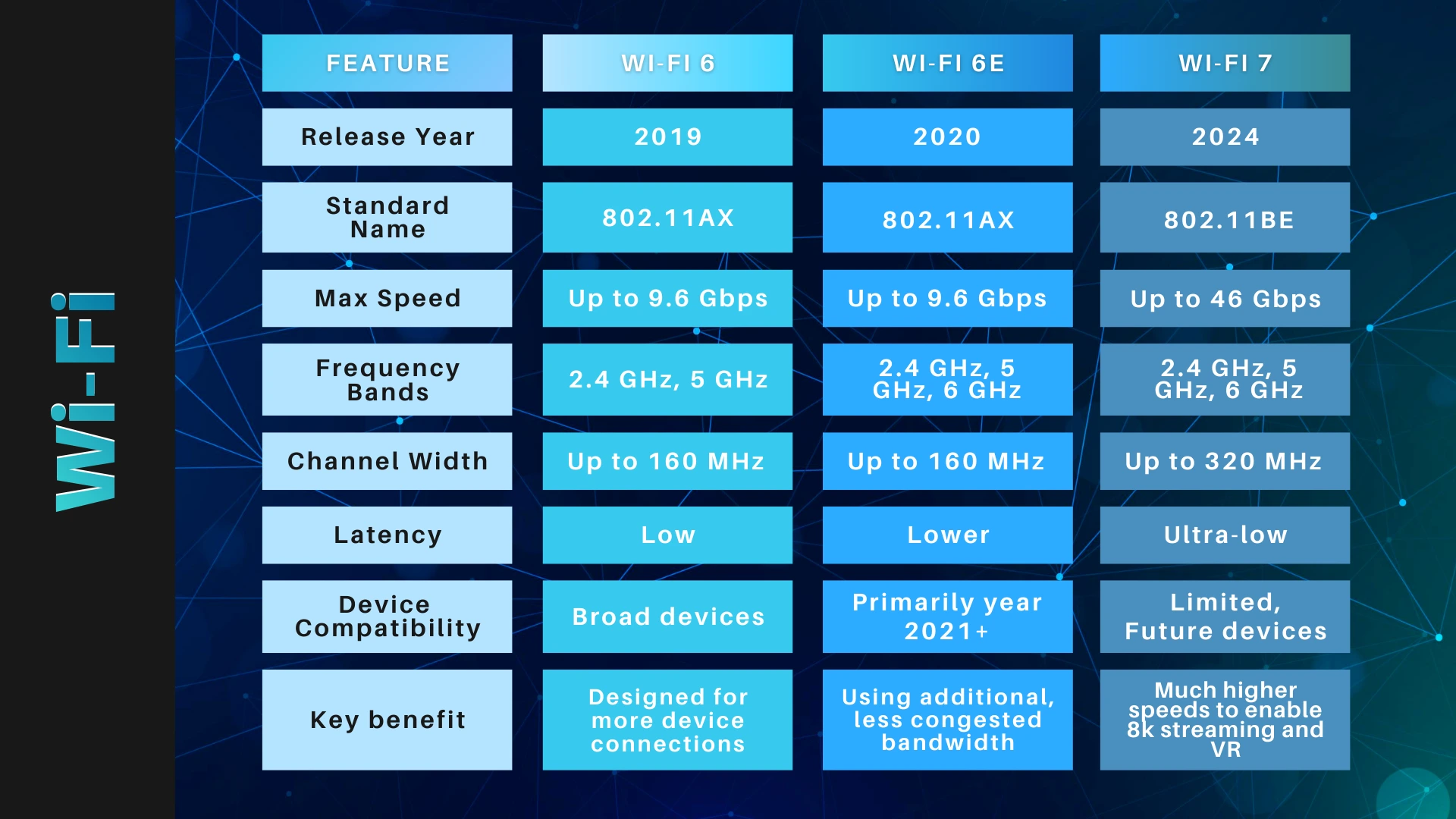
      Feature 

      Wi-Fi 6 

      Wi-Fi 6E 

      Wi-Fi 7 

      IEEE Standard 

      802.11ax 

      802.11ax 

      802.11be 

      Frequency Bands 

      2.4 GHz, 5 GHz       

      2.4, 5, 6 GHz 

      2.4, 5, 6 GHz 

      Max Data Rate 

      9.6 Gbps 

      9.6 Gbps 

      Up to 46 Gbps 

      Channel Width 

      160 MHz 

      160 MHz 

      320 MHz 

      Modulation (QAM)        

      1024-QAM 

      1024-QAM 

      4096-QAM 

      MIMO Streams 

      8×8 

      8×8 

      16×16 

      Primary Benefit 

      Efficiency      

      Congestion Relief         

      Extreme Throughput 

      While Wi-Fi 6 provides a foundation of efficiency by managing multiple devices simultaneously, and Wi-Fi 6E excels at bypassing congestion by opening the 6 GHz band, Wi-Fi 7 introduces specialized intelligence that maintains high-speed data paths even in the most interference-heavy environments. Each generation introduced a specific strategic advantage. Wi-Fi 6 optimizes multi-device traffic; Wi-Fi 6E provides a clean spectrum for high-performance hardware and Wi-Fi 7 maximizes throughput and reliability through advanced signal steering and massive data channels.

      Cybersecurity Focus: Why WPA3 is Non-Negotiable

      Previous Wi-Fi generations used other encryption standards like TKIP, WEP, WPA, and WPA2, which are all vulnerable to hacking. Wi-Fi 6, 6E, and 7 all utilize the modern WPA3 standard, which offers three critical defenses: 

      • Protection Against Brute-Force Attacks: WPA3 uses a handshake protocol called Simultaneous Authentication of Equals (SAE). This makes it so a hacker cannot capture the “handshake” and try to crack the password later. They have to be “live” on-site for every single guess, and the system can easily block them after a few failed attempts. This makes even a simple password significantly harder to crack (Cisco Meraki, 2026). 
      • Individualized Encryption for Guests: With Wi-Fi Enhanced Open (part of the WPA3 suite), every single guest connection is automatically encrypted with its own unique key. Your guests are protected, and your main network remains segmented and safe. 
      • Stronger Encryption for Enterprise: For industries like healthcare, finance, or defense contracting, Wi-Fi 7 supports WPA3-Enterprise 192-bit Mode. This aligns with the highest global security standards, ensuring that your financial records and customer data are shielded by encryption that would take current supercomputers trillions of years to break (Ruckus Networks, 2025). 

      Cybersecurity Focus: Why WPA3 is Non-Negotiable

      Previous Wi-Fi generations used other encryption standards like TKIP, WEP, WPA, and WPA2, which are all vulnerable to hacking. Wi-Fi 6, 6E, and 7 all utilize the modern WPA3 standard, which offers three critical defenses: 

      • Protection Against Brute-Force Attacks: WPA3 uses a handshake protocol called Simultaneous Authentication of Equals (SAE). This makes it so a hacker cannot capture the “handshake” and try to crack the password later. They have to be “live” on-site for every single guess, and the system can easily block them after a few failed attempts. This makes even a simple password significantly harder to crack (Cisco Meraki, 2026). 
      • Individualized Encryption for Guests: With Wi-Fi Enhanced Open (part of the WPA3 suite), every single guest connection is automatically encrypted with its own unique key. Your guests are protected, and your main network remains segmented and safe. 
      • Stronger Encryption for Enterprise: For industries like healthcare, finance, or defense contracting, Wi-Fi 7 supports WPA3-Enterprise 192-bit Mode. This aligns with the highest global security standards, ensuring that your financial records and customer data are shielded by encryption that would take current supercomputers trillions of years to break (Ruckus Networks, 2025). 

      How LeeShanok Network Solutions Can Help 

      Navigating the complexities of wireless network design and security can be overwhelming. Regardless, you shouldn’t have to become an IT expert to get a reliable, secure network for your business. That’s where LeeShanok Network Solutions comes in. 

      We specialize in providing enterprise-grade technology solutions tailored to the unique needs of businesses. Our team of experts can help you: 
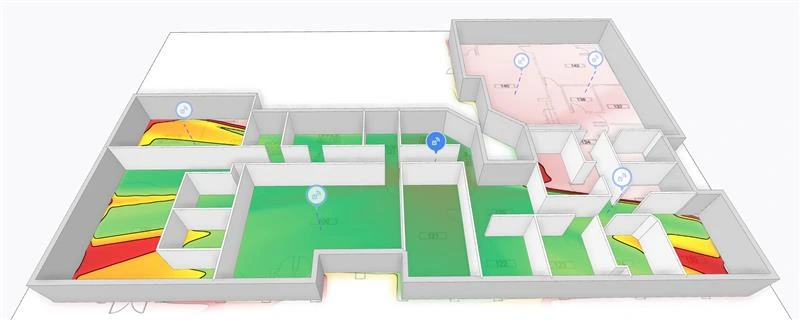
      • Perform a Comprehensive Site Survey: We use advanced tools to map your office’s layout, identify dead zones, and detect sources of interference to design a strong Wi-Fi coverage plan. 
      • Design and Deploy Point-to-Point Wireless: Our point-to-point wireless solutions provide a high-speed, reliable link between separate locations. 
      • Implement Secure, Property-Wide Wi-Fi Networks: For separated facilities, warehouses, or multi-floor offices, we design scalable networks that provide roaming and uniform coverage in every corner. 
      • Fortify Your Network Security: We implement network segmentation, deploy WPA3-Enterprise security, and ensure regular firmware updates to patch vulnerabilities. 

      Don’t let an outdated network hold your business back or leave your data exposed. Partner with LeeShanok Network Solutions to build a high-performance, future-proof, and secure wireless foundation for your company’s success. 

      Contact us today for a consultation and take the first step towards a better business network.


       Contact LeeShanok Network Solutions today to discuss your business security needs!


      LeeShanok Logo
      Copyright © leeshanok.com
      Website by CS Design Studios
      Newsletter Signup